
The ABCDE rule for checking molesVienaMed
Most moles are harmless. However, the emergence of a new mole or modification of an existing mole can be a signal that is worth evaluating by a dermatologist.
ABCDE rule is a simple method of skin self-observation. It can help you recognize certain characteristics associated with melanoma, one of the most serious forms of skin cancer.
It is important to note that the ABCDE rule does not establish a diagnosis. It only helps you to identify the changes for which a dermatological consultation is recommended.
What is melanoma?
Melanoma is a type of skin cancer that develops from cells responsible for producing skin pigment called melanocytes.
It can appear in an existing mole, but it can also present itself as a completely new stain or mole. Sometimes it also occurs in areas less exposed to the sun, such as the soles, palms or region under the fingernails. Early detection is important because melanoma can evolve and spread to other areas of the body. American Academy of Dermatology
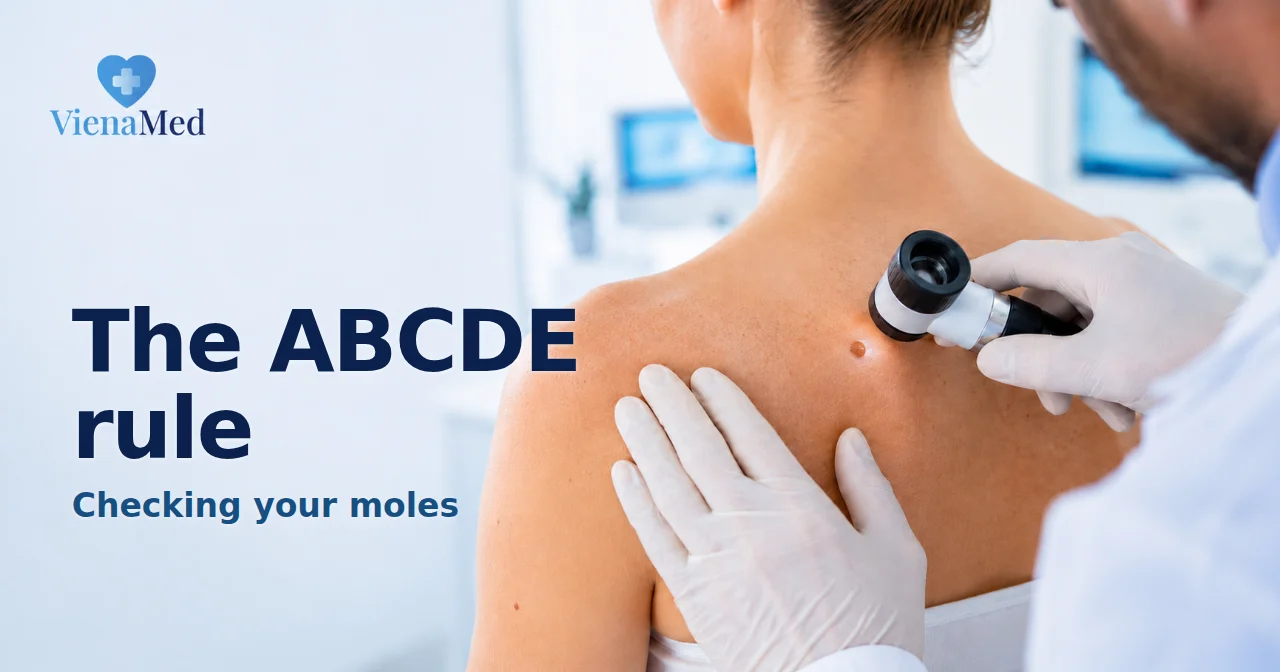
What does the ABCDE rule mean?
Each letter describes a feature that you have to follow when you check your moles.
A – Assymmetry
Look at the mole and imagine a line that divides it in half.
If the two halves do not resemble each other as shape, size or colour, the mole is asymmetrical and should be evaluated by a dermatologist.
The usual moles are usually round or oval and have a relatively symmetrical shape.
B – Irregular Boards
Check the edges of the mole.
An ordinary mole has generally smooth and well-delimited edges. A suspicious lesion may have edges:
- irregular;
- jagged;
- crested;
- unclear;
- weak delimited to the surrounding skin.
An irregular margin does not automatically mean that it is melanoma, but it is a reason to request a medical evaluation.
C – Non-uniform colors
A normal mole usually has a relatively uniform colour.
A mole containing several shades or changing color must be followed carefully. In the same lesion, shades of:
- light or dark brown;
- black;
- red;
- pink;
- white;
- blue or gray.
Uneven colour distribution is one of the signals included in the ABCDE rule. American Cancer Society
D – Diameter
The moles with a diameter greater than about 6 millimetres – the size of a pencil gum – require additional attention.
However, size should not be considered an absolute criterion. Melanoma can also be diagnosed when the injury is less than 6 millimetres. For this reason, a small mole, but new or changing, should not be ignored. American Academy of Dermatology
E – Evolution
Evolution is one of the most important alarm signals.
Schedule a consultation if you notice that a mole:
- change its size;
- change shape or colour;
- becomes more enlightened;
- start causing itching or pain;
- it is inflamed;
- bleeding or forming crusts;
- It looks different than it did before.
Any persistent change should be discussed with a dermatologist.
Attention also to the "sign of the ugly duck"
One person’s moles tend to resemble one another. A stain that looks completely different from all the others – through shape, color or size – is sometimes called the „ugly duckling.”
Even if it does not meet all the ABCDE criteria, such a lesion is worth checking. A melanoma does not always have all the classic signs, therefore any new or unusual spots must be followed.
How can you check your skin at home?
Examine your skin regularly in a well-lit room using a large mirror and, for hard-to-reach areas, a hand mirror. You can ask for the help of a person close to you to check your back and scalp.
Control the entire body, including:
- the face, neck and ears;
- the scalp;
- arms, palms and spaces between fingers;
- chest, abdomen and back;
- feet and feet;
- spaces between toes;
- the area under the fingernails;
- areas not normally exposed to the sun.
Photographs taken under the same light conditions may help to observe changes over time.
Can mobile applications identify melanoma?
Applications may be useful for photographing and monitoring moles, but should not be used to exclude possible skin cancer.
The result offered by an application does not replace clinical examination, dermatoscopy and, when the doctor considers it necessary, analysis of a tissue sample. The British Dermatologists Association warns that diagnostic applications can provide incorrect results and delay presentation to the doctor. British Association of Dermatologists
When do you have to go to the dermatologist?
Requests a dermatological evaluation if you notice:
- a new or unusual mole;
- a mole which changes shape, size or colour;
- a stain different from all the others;
- a lesion that causes itching or pain;
- an inflamed, bleeding or crusted mole;
- a wound that does not heal;
- a dark area under a fingernail, without a blow.
These signs don’t automatically mean it’s melanoma, but they need to be checked by a specialist. NHS – symptoms of melanoma
A suspect mole must not be ignored
Knowing their own moles and observing changes can help identify suspicious lesions early. The ABCDE rule is a simple and useful tool, but it cannot replace the dermatological consult.
If you noticed a new mole, a changing mole, or a stain that just gets your attention, don’t wait for all the signs of the ABCDE rule to appear.
For a dermatological evaluation in Vienna, the VienaMed team can support you with the appointment of the consultation, the identification of the right specialist and the coordination of the necessary medical investigations.
This article is intended for information purposes and does not replace the consultation, diagnosis or recommendations of a doctor.
I approached you separately and signs of non-melanoma skin cancer, including persistent skin lesions.