
Warning signs of non-melanoma skin cancerVienaMed
Non-melanoma skin cancer: the sign you shouldn't ignore
A stain, wound or skin change that doesn’t heal can seem insignificant. Sometimes it’s covered in a crust, it bleeds slightly, it seems to disappear, then reappears in the same place.
However, this may be one of the signs of non-melanoma skin cancer and should not be ignored.
Early skin cancer can be treated, in most cases, with very good results. The first step is the recognition of suspicious changes and scheduling a dermatological consult.
What is non-melanoma skin cancer?
The term „non-melanoma skin cancer” describes several types of cancer that develops in skin cells, but not in melanocytes – the cells from which melanoma occurs.
The most common forms are:
- basal cell carcinoma;
- Spinocellular or squamocellular carcinoma.
Both occur frequently in areas exposed to ultraviolet radiation, such as face, nose, ears, scalp, neck, shoulders, arms and hands.
The basal cell carcinoma usually develops slowly and spreads very rarely in other areas of the body. Left untreated, however, it can penetrate nearby tissues and cause significant damage.
Spinocellular carcinoma may have a faster development and, in certain situations, may spread to other regions of the body. For this reason, evaluation and treatment should not be delayed.
Main sign: a lesion that doesn't heal
Dr. Klaus Guggenberger draws attention to one of the main signs of alarm: a stain, a wound or a skin change that does not heal.
The injury may:
- to bleed for no obvious reason;
- repeatedly form a crust;
- cause itching or tenderness;
- appear to be healing, but to reappear;
- grow slowly;
- change its appearance or texture;
- to persist for several weeks.
According to the American Academy of Dermatology, skin cancer can resemble a wound that doesn’t heal, a basket that doesn’t disappear, a rough area or a small formation that bleeds.
Not every persistent wound is cancer. However, a lesion that does not heal normally should be examined by a dermatologist.
How can basal cell carcinoma look?
The basal cell carcinoma does not always look the same. It can be confused with a rash, a basket, a scar or a minor wound.
It may be in the form of:
- a small glossy or translucent swelling;
- a pink, reddish or close to skin color formation;
- a flat and irritated stain;
- a wound that bleeds and forms crusts;
- a lesion that heals apparently and then reappears;
- a scar-like area, although there was no wound;
- a formation with small blood vessels visible on the surface.
Most basal cell carcinomas occur in the head and neck, including on the nose, ears, eyelids or scalp. However, they can also develop on the chest, back, shoulders, arms or legs.
How can you check your skin at home?
Examine your skin regularly in a well-lit room using a large mirror and, for hard-to-reach areas, a hand mirror. You can ask for the help of a person close to you to check your back and scalp.
Control the entire body, including:
- the face, neck and ears;
- the scalp;
- arms, palms and spaces between fingers;
- chest, abdomen and back;
- feet and feet;
- spaces between toes;
- the area under the fingernails;
- areas not normally exposed to the sun.
Photographs taken under the same light conditions may help to observe changes over time.
Can mobile applications identify melanoma?
Applications may be useful for photographing and monitoring moles, but should not be used to exclude possible skin cancer.
The result offered by an application does not replace clinical examination, dermatoscopy and, when the doctor considers it necessary, analysis of a tissue sample. The British Dermatologists Association warns that diagnostic applications can provide incorrect results and delay presentation to the doctor. British Association of Dermatologists
Where do you have to check your skin?
Non-melanoma skin cancer develops most commonly on areas exposed to the sun. Therefore, it should be followed carefully:
- the face and nose;
- lips;
- the ears and the area behind them;
- scalp, especially in the case of people with rare hair;
- neck and neckline;
- shoulders;
- arms and hands;
- Back.
However, skin cancer can also occur in regions less exposed to the sun. It is therefore recommended to periodically check the entire surface of the skin.
Who's at greater risk?
The risk of non-melanoma skin cancer may increase in people who:
- have been exposed frequently and for a long time to the sun;
- have suffered repeated sunburn;
- used tanning machines;
- have pale skin;
- work or spend a lot of time outdoors;
- have a weakened immune system;
- have previously had a skin cancer;
- have numerous sun injuries;
- They’re getting older.
However, skin cancer can occur in any person regardless of skin color. On darker skin, lesions can be more difficult to recognise and can occur even in areas that are not frequently exposed to sunlight.
How is the diagnosis established?
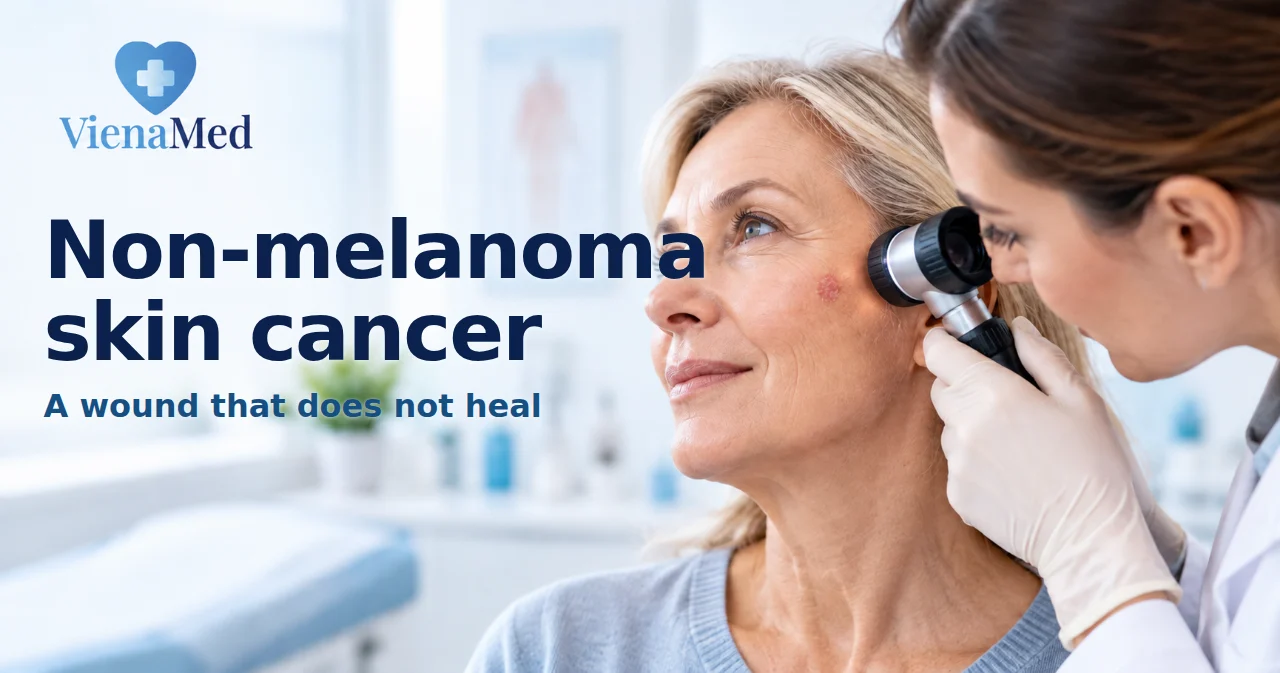
The consultation starts with examining the skin and discussing the evolution of the lesion. The doctor can use a dermatoscope, an instrument that allows you to observe in detail the structures on the surface and in the depth of the skin.
If the lesion raises suspicion, a biopsy may be recommended. It involves taking a small tissue sample, which is analysed under a microscope.
The anatomopathological examination determines whether the lesion is cancerous and what type of cells are involved. The external appearance or a photograph is not sufficient to confirm the diagnosis.
What treatment options are there?
Treatment is chosen according to the type of cancer, the size and location of the injury, its depth and the overall condition of the patient.
Options may include:
- surgical removal of the lesion;
- Mohs micrographic surgery, in some cases;
- curettage and electrocoagulation;
- cryotherapy for certain superficial lesions;
- local treatments;
- radiotherapy, when surgery is not appropriate;
- Systemic therapies for advanced cases.
The doctor determines the right method after confirmation of the diagnosis. Treatment is usually simpler when cancer is discovered at an early stage.
How can you protect your skin?
Exposure to ultraviolet radiation is one of the main risk factors. To protect the skin it is recommended:
- avoid prolonged exposure to the sun during hours of intense radiation;
- use a sunscreen with wide spectrum protection;
- Reapply solar protection as instructed by the product;
- wear a hat, sunglasses and clothing covering the skin;
- avoid tanning appliances and salons;
- examine your skin regularly;
- go to the dermatologist if you notice a new or persistent injury.
Solar protection is important throughout the year, not just during summer or holidays.
Don't ignore a wound that doesn't heal
A small and seemingly insignificant injury can sometimes hide a problem that requires treatment.
If you notice a stain, wound, crust or formation that persists, it bleeds or reappears in the same place, it programs a dermatological consult.
Do not wait for the injury to become painful or to increase. A timely evaluation may allow for rapid diagnosis and choice of appropriate treatment.
This article is intended for information purposes and does not replace the consultation, diagnosis or recommendations of a doctor.
For the changes you can see in moles, read also guide on ABCDE rule.